
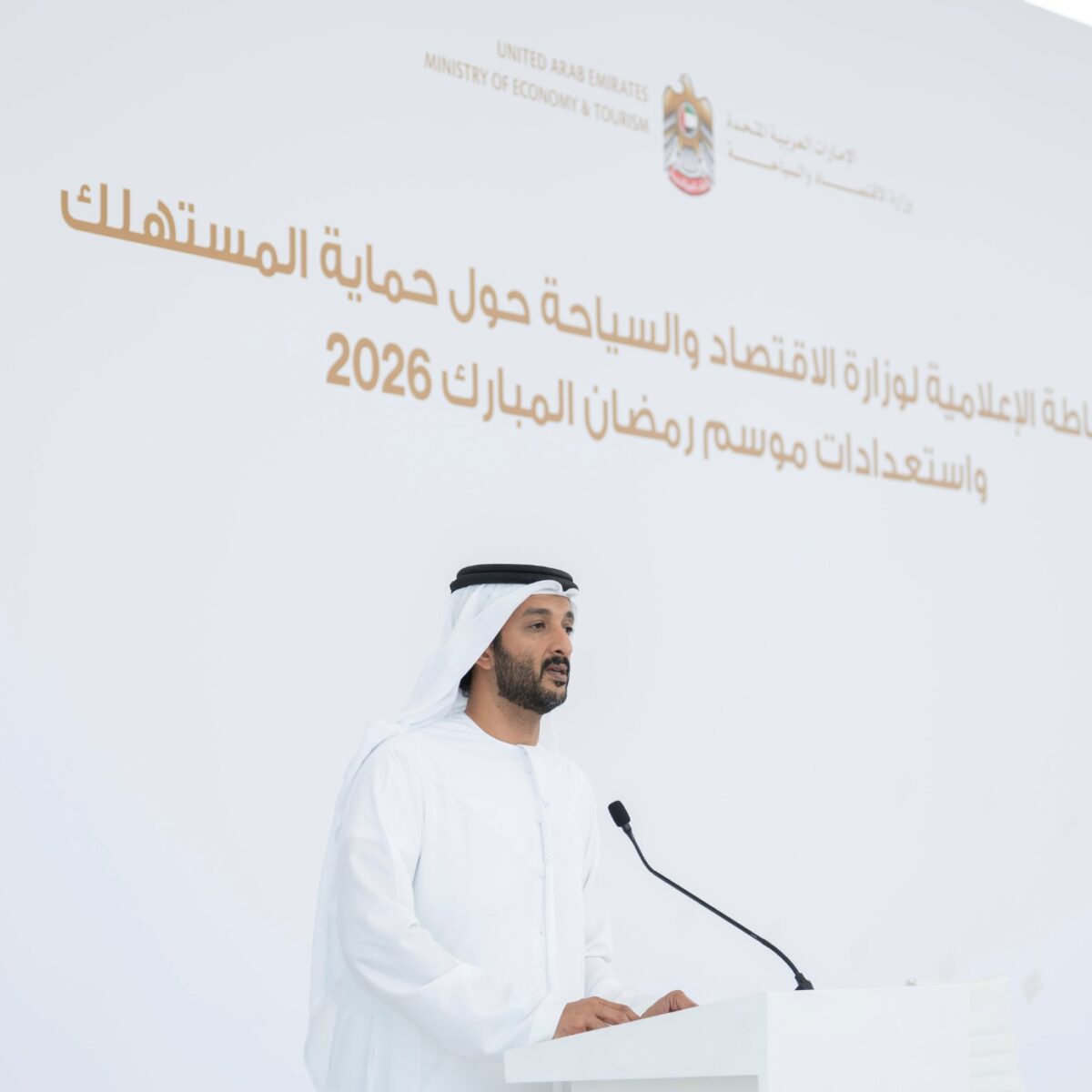
ABU DHABI, 11th February, 2026 (WAM) — The Ministry of Economy and Tourism (MoET) organised a media briefing outlining new measures to strengthen oversight of product and service prices across UAE markets during the Holy Month of Ramadan and safeguard consumer rights.
Abdulla bin Touq Al Marri, Minister of Economy and Tourism, said the UAE has made significant progress in building a comprehensive legislative and regulatory framework for consumer protection, reinforcing consumer confidence and supporting a fair and transparent business environment.
He said the ministry has intensified coordination with federal and local authorities, particularly through the Supreme Committee for Consumer Protection, while strengthening engagement with cooperatives, the private sector and other stakeholders to ensure compliance with consumer protection laws and promote sound commercial practices.
Bin Touq noted that most notable among these legislative frameworks is the Federal Decree-Law No. 5 of 2023 amending certain provisions of Law No.15 of 2020 on Consumer Protection, along with its Executive Regulations. Together, they impose over 43 obligations on suppliers to ensure the highest standards of consumer protection, enhance the effectiveness of deterrent measures against any violations or breaches, and achieve consumer satisfaction and well-being within a fair and safe commercial environment.
To enhance price stability, the ministry has implemented the “Pricing Policy for Essential Consumer Goods,” which prohibits price increases for nine key items — including cooking oil, eggs, dairy products, rice, sugar, poultry, legumes, bread and wheat — without prior approval from the Ministry of Economy and Tourism. Other goods remain subject to market competition and supply-demand dynamics.
Furthermore, Bin Touq highlighted that the issuance of Federal Decree-Law No. 14 of 2023 on Modern Technology-based Trade has played a key role in regulating and advancing e-commerce within the UAE markets.
The decree clearly defines guaranteed consumer rights, including the provision of adequate technical protection measures that enable consumers to purchase goods and services safely through online platforms, the availability of secure digital payment methods and channels in accordance with the approved or specified technical and regulatory standards set by the competent authority, without imposing additional fees. The law also ensures the protection of data in line with the regulatory, professional, and technical requirements established under various legislation.
Also, the Cabinet issued Resolution No. 200 of 2025 concerning regulations on violations and administrative penalties for acts committed in violation of the provisions of Federal Decree-Law No. 14 of 2023 on Trading by Modern Technological Means.
The minister said the UAE maintains a robust strategic reserve of essential goods, ensuring sufficient supply during Ramadan without unjustified price increases. He attributed this to prudent national policies and the leadership’s support.
MoET will coordinate with local economic departments to monitor price compliance and availability of essential goods. The ministry plans to hold 26 meetings with major suppliers and importers and conduct 420 inspection campaigns during Ramadan. Legal action will be taken against any violations.
In cooperation with local authorities, the ministry will also launch awareness campaigns promoting responsible consumption, including guidance on consumer rights and communication through its toll-free number (8001222).
He added that the ministry will oversee Ramadan promotions announced by cooperatives and retail outlets, including discounts exceeding 50 percent on selected items and “Ramadan baskets” containing essential goods such as rice, sugar, flour, grains, oil, legumes and milk.
MoET has activated an online price monitoring system linked to 627 major retail outlets — representing more than 90 percent of domestic trade in essential goods — enabling real-time tracking of prices and identification of violations. Retailers submit periodic price lists, which are automatically analysed against reference prices to detect discrepancies.
The ministry also warned against committing any violations or illegal practices, including increasing prices of the nine essential consumer goods, whether by the trader or supplier individually and without obtaining prior approval from the ministry; manipulating goods-related data and withholding information from the ministry; providing misleading data to the ministry hindering monitoring activities; and prior agreement between the supplier and trader to collectively raise prices.
The system for implementing administrative penalties and fines in the ministry follows a graduated approach aimed at rectifying violations and promoting compliance with existing legislation. This approach takes into account the nature, severity, frequency of the violation, and its impact on the market and consumer.
Depending on the type of violation, measures may include issuing a written warning and granting the violator a deadline to rectify the situation, or imposing financial fines starting from AED500 and reaching up to AED100,000.
Additionally, other administrative actions may be taken, such as the temporary closure of the establishment for varying periods. In severe cases or upon repeated violations, stricter measures proportionate to the gravity of the violation may be implemented.
The ministry and economic development departments jointly conducted approximately 155,218 inspection tours across various markets in the country during 2025, which resulted in 7,702 violations. The tours monitored the placement of price labels, the quality of products, and ensured the prevention of commercial fraud and infringement of trademarks.
The ministry received 3,167 complaints via its website last year. These complaints were handled with high efficiency, as 93.9 percent of them were resolved, reflecting the effectiveness of the electronic system and the prompt response of the competent authorities in protecting consumer rights.
The ministry received 130 product recall requests last year, leading to the recovery of 551,976 goods. This reflects the continuous follow-up on product quality and safety and ensuring consumer protection.
The ministry called upon consumers to adhere to conscious purchasing practices, such as retaining receipts and verifying them against purchases, as they are the fundamental guarantee of their rights. The ministry also encourages interaction with regulatory authorities and communication through its official channels to submit complaints or report harmful practices.