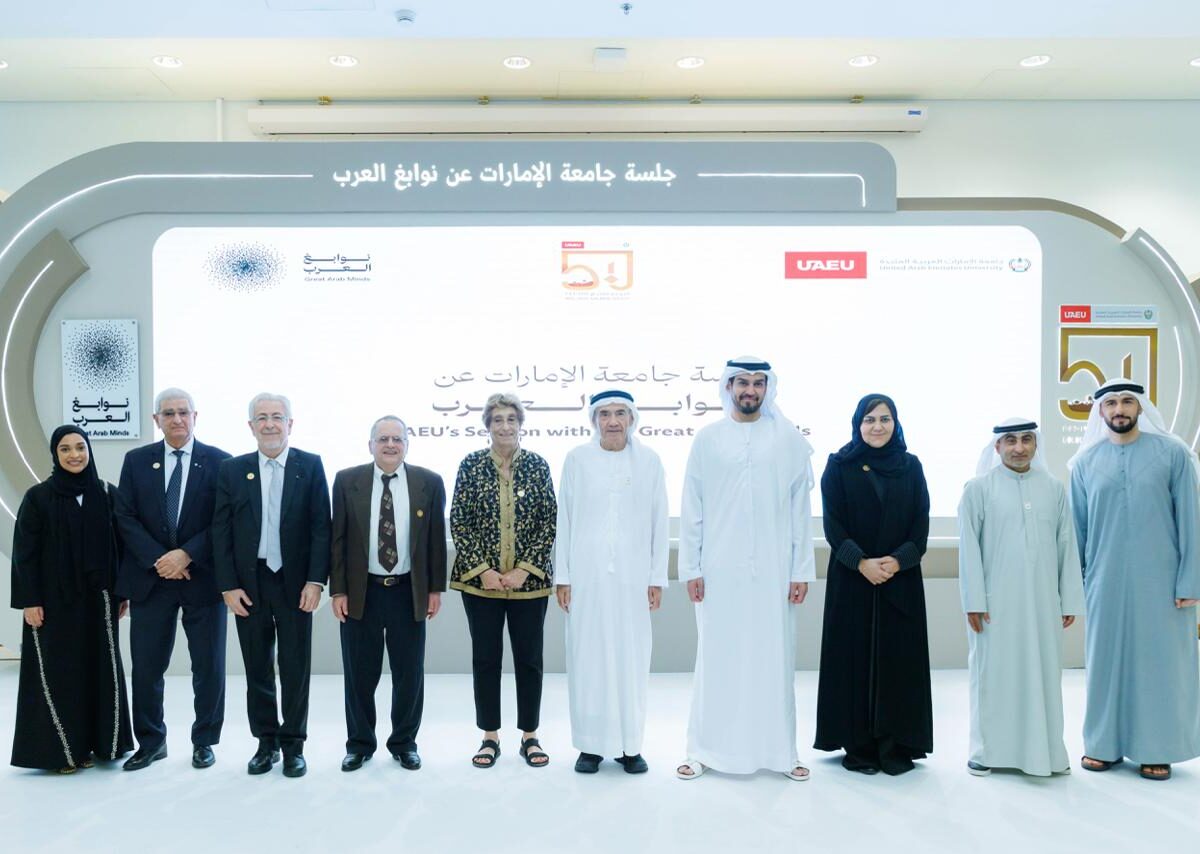
AL AIN, 16th February, 2026 (WAM) — The United Arab Emirates University (UAEU) hosted its “Great Arab Minds Session” at the UAEU Library Auditorium, featuring winners of the Great Arab Minds Award, academics, and national and international researchers.
The session opened with remarks by Zaki Anwar Nusseibeh, Cultural Advisor to the UAE President and Chancellor of UAEU. He affirmed that the Great Arab Minds initiative is of great significance today, as it highlights the contributions of Arab thinkers, creators, and scientists over the past millennium and in the present era.
He emphasized that Arab contributions both historically and currently have formed an integral part of the development of science and human thought globally, shaping scientific approaches and research methodologies across civilizations.
He added that the initiative affirms the authority of Arab intellect through the perspectives it develops, the questions it raises, and the interpretations it offers. He noted that UAEU, through this session, seeks to connect scientific achievement with the human dimension by directing research toward community service and fostering a balanced understanding of the role of knowledge in shaping the future.
He stressed that human advancement is achieved not only through technology, but through an integrated knowledge system that combines knowledge with meaning and responsibility.
The session featured two main themes. The first, “Rethinking the Future: Arab Contributions to Science and Technology,” explored examples of Arab achievements in basic and applied sciences, as well as the role of scientific research in supporting innovation and anticipating future challenges. Speakers included Prof. Nivine Khachab, Associate Dean of Physical Sciences and Professor of Chemistry at KAUST, Kingdom of Saudi Arabia; Prof. Badi Baltagi, Distinguished Professor of Economics at Syracuse University; and the session was moderated by Dr. Omar Al Bastaki from UAEU.
The second theme, “Health, Society & Humanities: The Broader Impact of Arab Scholarship,” focused on the role of research in advancing public health, addressing social issues, and enhancing the contribution of the humanities in shaping public policy. Speakers included Dr. Nabil Seidah, Director of the Biochemical Neuroendocrinology Research Unit at the Montreal Clinical Research Institute; Prof. Oussama Khatib, Professor of Computer Science and Director of the Robotics Laboratory at Stanford University; and Dr. Suad Amri, Founder and Director of Riwaq Center, Palestine. The session was moderated by Dr. Lemya Alhmoudi from UAEU.
The session concluded with an open discussion with attendees, followed by the honoring of participating speakers in recognition of their scientific and intellectual contributions. This reflects UAEU’s continued commitment to supporting intellectual initiatives that enhance the presence of Arab minds in the global scientific and knowledge landscape, while linking research to human and societal priorities.