
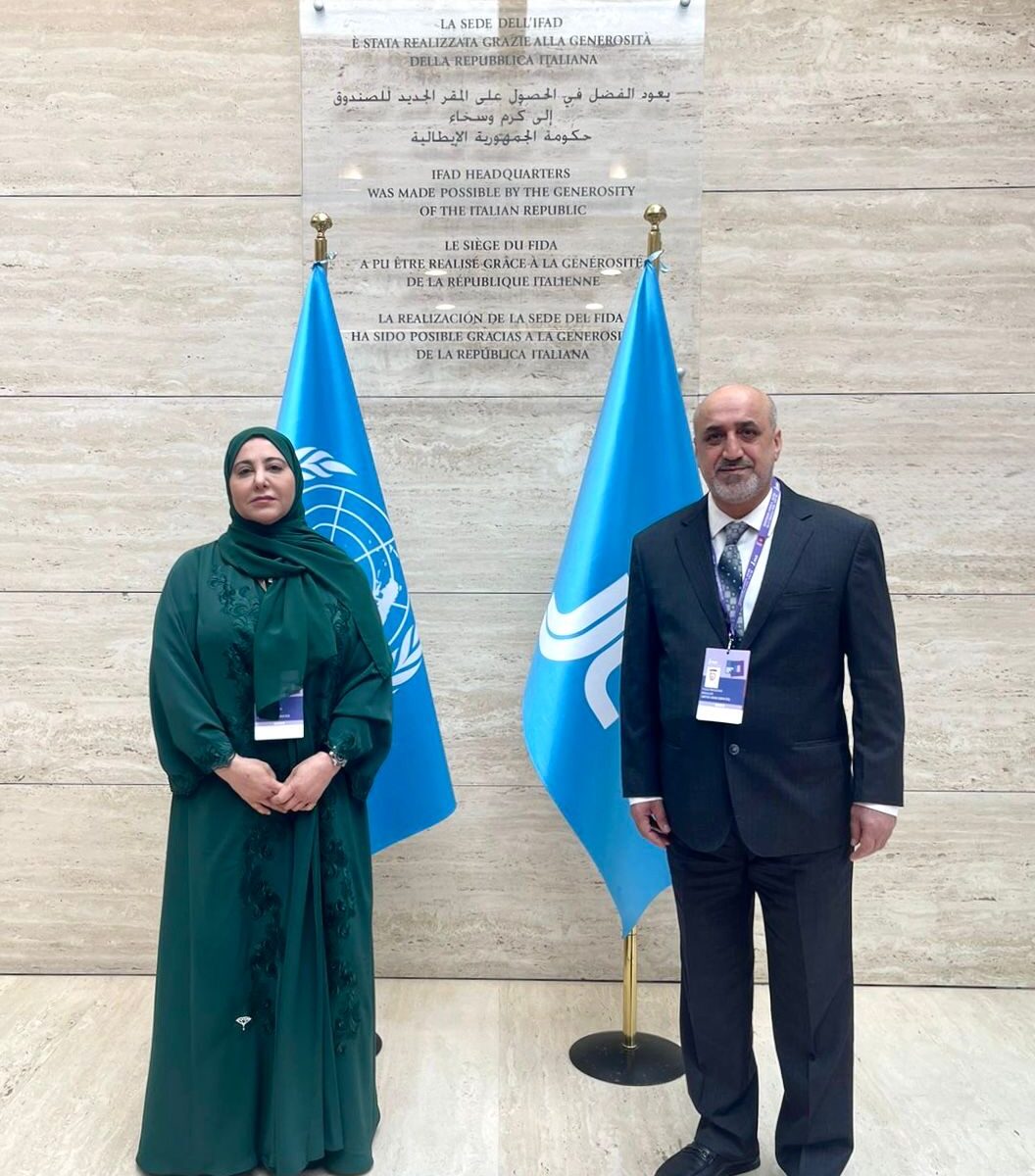
ROME, 13th February, 2026 (WAM) — The UAE has participated in the 49th session of the IFAD Governing Council, held from 10th to 12th February 2026 at the headquarters of the International Fund for Agricultural Development (IFAD)in Rome, Italy.
Represented by the Ministry of Finance, the UAE’s delegation included Mariam Mohamed Al Amiri, Assistant Under-Secretary for the Government Financial Management Sector at the Ministry of Finance, and Yousif Bin Hajar, Member of the Executive Board of IFAD. The meeting discussed ten key items.
The first day of the event featured leaders’ dialogues focusing on the role of international financial institutions in mobilising financing to support rural communities, as well as water security as a foundation for resilience and enhanced food security. Discussions on the second day touched on governance and partnerships, including deliberations on the Fund’s budget-related agenda items.
The annual Governors’ Roundtable Meeting was also organised to discuss strategic priorities and outline the Fund’s future direction under the main theme of the session, “From Farm to Market: Investing in Young Entrepreneurs.”
The third day concluded with the launch of the Consultation on the Fourteenth Replenishment of IFAD’s Resources, providing a platform for governors to exchange views on strategic priorities and shape the next phase of discussions initiated during the session.
The Council commenced its agenda with the election of the Bureau of the Governing Council, followed by discussions on the Report of the Thirteenth Replenishment of IFAD’s Resources, the results-based Programme of Work, the 2026 administrative and capital budgets, and the projected budget for 2027 and 2028.
Speaking at the Roundtable Meeting, Mariam Mohamed Al Amiri stressed the UAE strongly believes that investment in rural populations is a fundamental pillar of global food security and a foundation for economic and social stability.
In light of escalating climate challenges and mounting pressures on global food systems, she stressed the need to channel resources toward strengthening the long-term resilience and sustainability of rural communities, particularly through climate-smart agriculture and sustainable water resource management.
Al Amiri further emphasised that mobilising innovative financing and deepening partnerships with the private sector, sovereign wealth funds, and development banks play a key role in amplifying the development impact of available resources.
She highlighted that innovation, technology, and digital transformation, alongside strengthened South–South and triangular cooperation, are essential enablers of tangible, sustainable outcomes that improve rural livelihoods.
Al Amiri reaffirmed that the UAE is committed to collaborating with international partners to ensure the success of the Fourteenth Replenishment and to accelerate inclusive and sustainable rural transformation.
The Executive Board of IFAD recommended the approval of the 2026 Programme of Loans and Grants in the total amount of US$1.633 billion, including a lending programme of US$1.609 billion and grants of US$20.6 million, subject to adjustment during 2026 in line with available resources.
The recommendations further called for follow-up on IFAD’s operational programme and indicative plan for 2027–2028, as well as a review of progress reports related to the Heavily Indebted Poor Countries (HIPC) Initiative, the Performance-Based Allocation System (PBAS), the Borrowed Resources Access Mechanism (BRAM), and the implementation of IFAD’s Exit Policy.
The UAE is a founding member of the International Fund for Agricultural Development, having joined pursuant to Federal Decree No. (9) of 1979. Since its establishment, the UAE’s cumulative contribution has reached approximately US$66.18 million (AED243 million), representing 0.56 percent of the Fund’s total resources of US$11.77 billion. The UAE has contributed to all thirteen previous replenishments of the Fund’s resources in support of improving rural livelihoods, most recently with a US$3 million contribution to the Thirteenth Replenishment for the period 2025–2027.
Strategic cooperation between the UAE and IFAD aims to reinforce sustainable agricultural production and strengthen food security through enhanced partnerships and expanded collaboration with relevant national institutions. These include the Ministry of Finance, the Ministry of Climate Change and Environment, the Abu Dhabi Fund for Development, the International Center for Biosaline Agriculture (ICBA), the Khalifa International Award for Date Palm and Agricultural Innovation, and the Arab Authority for Agricultural Investment and Development.
Cooperation also extends to capacity building and the development of national expertise through IFAD’s training and secondment programmes under the Framework Partnership Agreement signed in March 2015. In addition, collaboration prioritises innovation and green finance, leveraging IFAD’s expertise to address climate change, food and water security, and disaster risks through sustainable financing solutions.
The 49th session also coincides with the beginning of the International Year of Women Farmers, proclaimed in recognition of the pivotal role women play in agrifood systems worldwide.
Women account for more than half of IFAD project participants, while over 60 percent of the Fund’s active portfolio is youth-sensitive, reaching more than 12 million young people globally.
IFAD continues to mobilise and provide concessional financing to support projects aimed at improving food production systems and livelihoods for the poorest populations in developing countries, as well as developing agricultural sectors, managing natural resources, and advancing rural development.
These efforts contribute to strengthening food security and sustainable economic growth through strategic partnerships that deepen institutional cooperation, align programmes with member states’ priorities in food security and sustainability, and enhance development impact through innovative financing and capacity building.