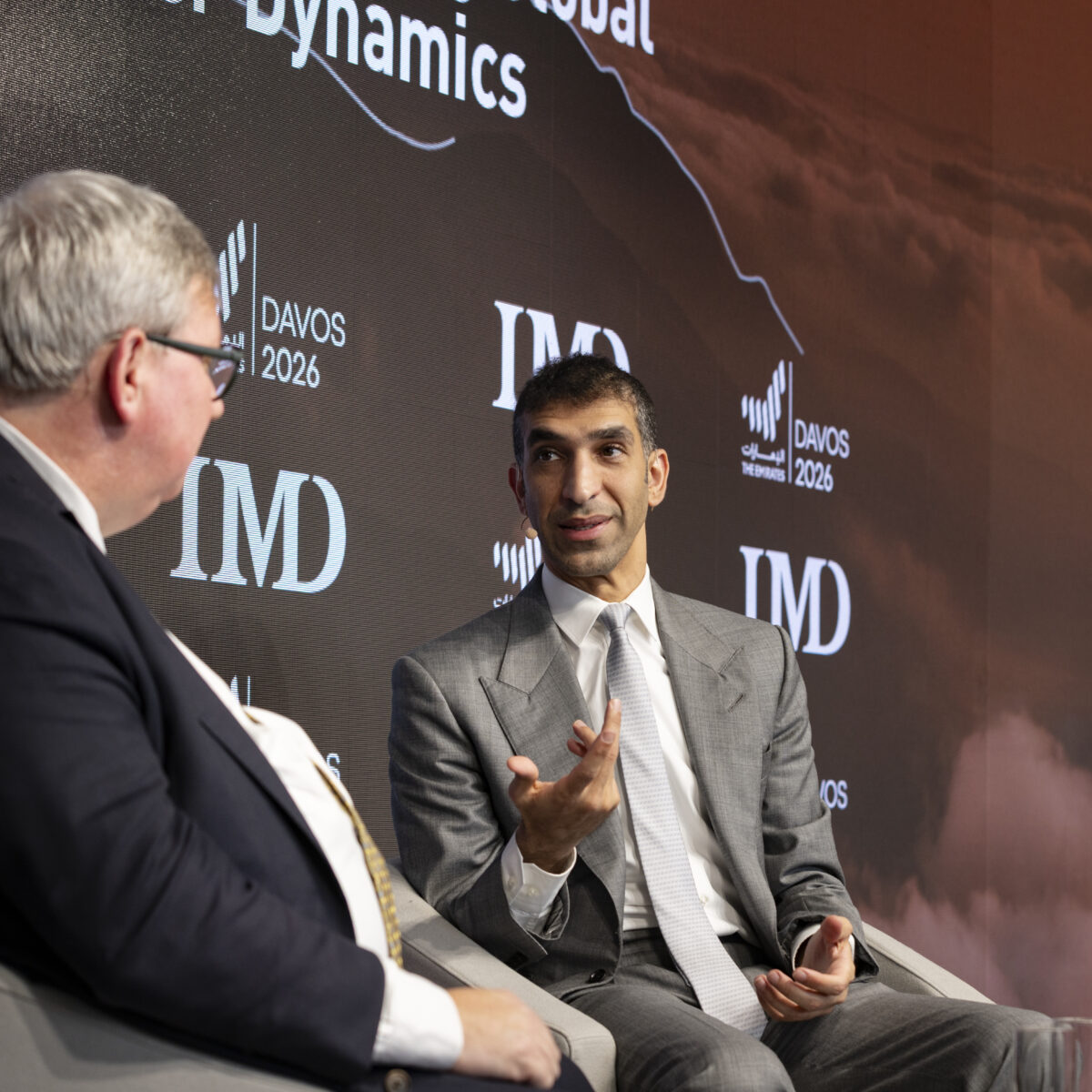
DAVOS, 22nd January, 2026 (WAM) — The United Arab Emirates took part in a high-level dialogue held during the current edition of the World Economic Forum in Davos, focusing on the UAE’s growing role in shaping the future of global trade amid accelerating geopolitical shifts and changes in global economic power. The session addressed how open and rules-based trade can be sustained at a time of increasing fragmentation and realignment of global supply chains.
The session brought together Dr. Thani Al Zeyoudi, Minister of Foreign Trade, and Simon Evenett, Professor of Geopolitics and Strategy at IMD. The discussion was held as part of the official programme of the World Economic Forum, and formed part of broader dialogues examining shifts in global trade governance and emerging models of international economic cooperation.
During the dialogue, Dr Thani Al Zeyoudi outlined the UAE’s approach to international trade, stressing the importance of openness, partnership, and flexibility in responding to global change.
Al Zeyoudi noted that as traditional centres of trade leadership turn inward, the global economy increasingly requires agile and credible partners capable of safeguarding open markets and strengthening cooperation across regions.
Al Zeyoudi explained that the UAE’s trade policy is anchored in building bridges between economies, enhancing market access, and supporting a rules-based trading system that benefits both developed and emerging markets.
Dr Al Zeyoudi highlighted the Future of Investment and Trade Partnership as a forward-looking model that reflects the UAE’s commitment to shaping next generation trade frameworks.
He explained that the partnership focuses on facilitating investment flows, modernising trade rules, and responding to new realities such as digital trade, supply chain resilience, and sustainable growth. He added that the initiative demonstrates how collaborative leadership can help preserve openness while adapting to changing global dynamics.
Al Zeyoudi also underlined the UAE’s expanding network of comprehensive economic partnership agreements and its role as a trusted global trade hub linking East and West. He noted that these efforts reinforce the country’s position as a platform for dialogue, cooperation, and practical solutions at a time when global trade requires renewed confidence and predictability.
For his part, Simon Evenett examined the broader geopolitical context shaping global trade, noting that the diffusion of economic power is creating space for new actors to play a constructive leadership role.
Evenett observed that smaller and mid-sized economies with open policies, strong institutions, and diversified trade relationships are increasingly well positioned to support stability in the global trading system.
Evenett pointed to the UAE as an example of how proactive trade diplomacy and strategic partnerships can help maintain momentum in global commerce despite rising uncertainty.
The discussion addressed the question of whether the global economy is entering a new phase in which leadership in trade is no longer centred on a single power, but rather shared among countries that demonstrate credibility, consistency, and a commitment to cooperation.
Participants explored what effective leadership in global trade looks like in this context, and how countries such as the UAE can contribute to shaping future norms and practices.
The session also highlighted the importance of aligning trade policy with broader economic priorities, including supply chain resilience, investment facilitation, and sustainable development. Speakers agreed that future trade leadership will depend not only on market size, but on the ability to build trust, adapt to change, and deliver tangible value to businesses and societies.
The dialogue reflects the UAE’s active participation at the World Economic Forum 2026 and its ongoing engagement in global discussions on trade, investment, and economic governance.
Through its presence at Davos, the UAE continues to position itself as a forward-looking partner committed to supporting open trade, fostering international cooperation, and contributing to a more resilient and balanced global economy.